Before buying lift kits and truck accessories in Reading, choose between a leveling kit and a complete suspension lift. A leveling upgrade corrects factory rake while preserving daily manners, and a suspension lift adds clearance, wheel travel, and bigger tire options. Collect precise year, trim, drivetrain, and suspension details to confirm Rough Country fit. Budget for tires, alignment, and add-ons like steps, lights, or liners—you'll understand how the right setup develops.
Key Takeaways
- Choose a leveling kit to remove factory rake while keeping near-stock performance and fitting bigger tires for daily driving.
- Pick a suspension lift for more ground clearance, suspension travel, and off-road performance, knowing handling and steering may shift.
- Check exact fitment with your truck's year, model, make, drivetrain, trim, cab, bed, and suspension system before ordering Rough Country items.
- Align lift height and shock choice with your use, addressing commuting, trail use, towing, or intensive off-road driving.
- Budget for more than the kit price, covering alignment, labor, wheels, tires, shocks, and add-on accessories like steps, lights, and liners.
Suspension Lift Kits vs Leveling Kits
Even though both enhancements change your truck's look, leveling kits and suspension lift kits solve separate issues and give different outcomes. A leveling kit tends to raise the front to meet the rear, correcting factory rake with limited change to geometry, ride height, and everyday drivability. You select one when you want a cleaner look and capacity for bigger tires.
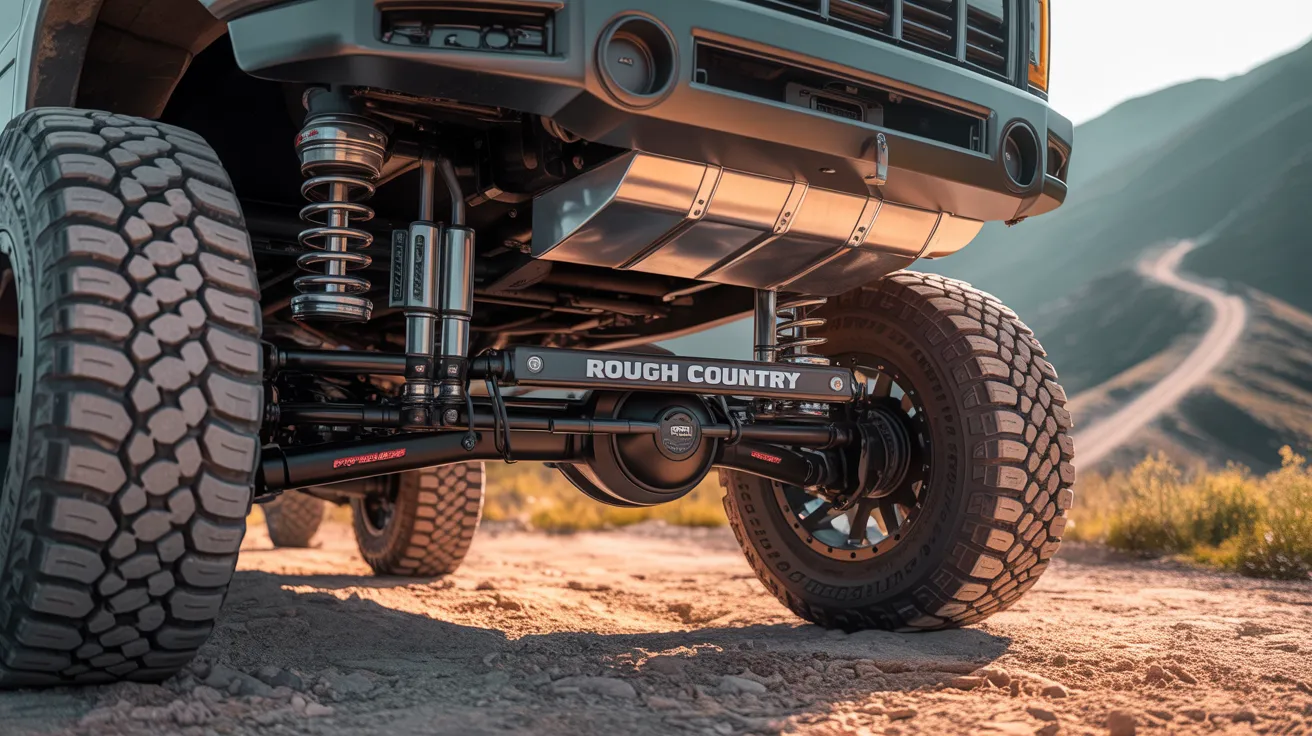
A suspension lift kit raises the whole truck and modifies key components to produce more clearance and suspension travel. You'll notice larger improvements in ride height, off-road performance, and tire options, but you should expect handling tradeoffs, steering changes, and a higher center of gravity. If you want mild visual correction, level it. If you require true clearance and articulation, use a suspension lift and design the supporting mods based on your use case.
Which Rough Country lift kit matches your truck?
Begin by documenting your truck's year, make, and model, drive configuration, and primary application, because Rough Country designs lift kits based on specific platform requirements and performance goals. This data shows which structural components and hardware can mount correctly without spacing or alignment conflicts.
Next, verify factory ride height, cab and bed configuration, axle configuration, and whether your truck has 2WD, 4WD, or adaptive suspension. Rough Country fitment guides help with this step, but you still need to verify model compatibility against trim-specific components and factory package differences. A kit that fits a Silverado 1500 may not fit a Trail Boss, and a Ram with air suspension necessitates different provisions than a vehicle with coil springs. When you confirm exact fitment first, you avoid installation issues, hardware conflicts, and return hassles.
Determine which Rough Country lift kit suits your driving preferences.
Align the kit to your driving style, and you'll get enhanced ride quality, longevity, and additional tire clearance without paying for unused capability. If commuting is your truck's main use, pick a light leveling kit from Rough Country or a suspension lift of 2 to 3.5 inches calibrated for daily comfort and consistent steering feel.
If you split time between pavement and trails, upgrade to essential information a lifted suspension that includes upgraded shocks and optimized control arm positioning. You'll gain enhanced off-road performance, better articulation, and room for larger tires without overstressing OEM components. For heavier trail use, focus on raised struts, N3 or Vertex shock dampers, and setups that keep driveline angles correct under compression. The ideal Rough Country setup should match load, speed, terrain, and how much ride firmness you'll actually tolerate.
Top Rough Country Truck Accessories
Enhance your lift setup by adding Rough Country add-ons that fix the actual issues you'll encounter after lifting and upgrading tires. Begin with upgraded entry steps or skid plates, that restore entry to the cabin and provide lower-vehicle protection once your truck sits higher and wider.
Then focus on sight lines and handling. Rough Country LED lightbars expand usable vision on dark trails, job sites, and rural roads without hard-to-manage integration. Cabin protection and floor mats protect the cabin from dirt, rocks, and moisture you'll drag in after trail use. Fender flares reduce wheel spray and match the expanded stance created by bigger rubber. For hauling and rescue use, reinforced hitches, tow hooks, and winch-ready bumpers contribute capability without sacrificing compatibility. Select add-ons that complement your truck's new geometry and usage demands.
What Budget Should You Plan for Your Build?
After selecting the lift kit and added components, set aside a budget above the base price. You'll need money for shock units, wheels, tires, alignment, work costs, and any drivetrain or steering corrections your platform requires. Brand reputation matters; premium systems typically deliver stricter specs, smoother rides, and easier installations.
In terms of practical budget estimates, assume entry-level spacer or leveling systems to begin at lower costs, whereas full suspension setups with control arms, adjusted dampers, and larger wheels climb quickly. Installation complexity, service fees, and recalibration work can add substantially. You must also budget supplementary upgrades including gear changes, brake systems, and recovery equipment if trail use is planned. When finances are limited, compare loan options cautiously and stress reliability instead of fancy additions.
Frequently Asked Questions
How Do Lift Kits Influence Warranty Coverage?
Yes, lift kits could impact your factory warranty coverage, but they won't necessarily void it. You face warranty implications if a dealer proves your lift modification caused or helped cause a failure. Powertrain, steering, suspension, and drivetrain claims often trigger dealer disagreements. You should keep installation documents, use quality components, and keep service intervals. This helps you challenge denied claims and preserve protection where the modification isn't responsible.
Will Larger Tires Need Re-Gearing?
Yes—should you jump several tire sizes, you'll typically need gear changes. For example, when you move from 31s to 35s, your truck may feel slow, hunt for gears, and build drivetrain stress under load. Re-gearing reestablishes optimized gear ratios, helping you recover acceleration, towing performance, and transmission behavior. You may skip regearing for modest tire increases, but if performance, fuel mileage, or gear shifting decline, it's typically the best option.
How Often Should Lift Kit Components Be Inspected?
You should inspect lift components after the first 500 miles, then at every oil change or 3,000 to 5,000 miles, based on use. Regular maintenance checks enable you to catch wear on bushings, shock fluid leaks, damaged brackets, and alignment concerns ahead of time. Check Fastener torque post-aggressive terrain driving, cargo hauling, or hard impacts. If you drive in mud, salt, or rough terrain often, shorten intervals and inspect suspension and steering parts at faster intervals.
Can a suspension kit modify your truck's towing and payload performance?
Yes, a lift kit can affect your towing and payload capacity. When you raise ride height for additional clearance, you change suspension design, weight distribution, and leverage on components. That can reduce stability under weight and boost drivetrain stress, especially with larger tires. You should adhere to your OEM specifications unless an professionally designed kit clearly outlines updated ratings. Proper alignment, gearing, and brake performance matter too.
Is alignment work necessary once you add truck upgrades?
Yes—if attachments adjust ride height, suspension structure, steering direction, or tire size, you must have an alignment. You'll feel the theory fast: slight changes can force your truck off-center, scrub tread, and compromise handling. A quality alignment restores camber, caster angle value, and toe angle value to spec. After certain installs, you should also arrange brake calibration for driver-assist accuracy. You protect tire life, steering exactness, and real-world safety by confirming alignment straight away.
Wrap-Up
Choosing the proper lift configuration and products relies on how you use your truck, what stance you want, and your cost capacity. When you tune a Rough Country suspension to your driving approach, you'll get durability, space, and aesthetics that work together like a perfectly balanced engine. Add wise upgrades, plan your spend carefully, and you'll build a truck remaining practical on the road, capable off it, and equipped for anything next.